
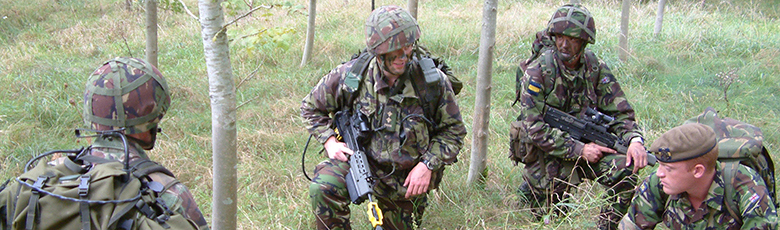
Chelton has designed a new body-worn antenna for the Thales UK Future Integrated Soldier Technology (FIST) programme, part of the Soldier Modernisation programme.
Thales UK is the prime contractor for trials of FIST, working in partnership with the UK Ministry of Defence, the Defence Procurement Agency, the DCC Integrated Project Team and other stakeholders, to deliver this revolutionary programme.
The system, linking radios, computers, GPS, weapon sights and cameras, is experimental and the
original trials were designed to check individuals' functionality requirements during a
variety of operations, as compared to soldiers with conventional equipment. One of the radio
communication problems to be overcome by FIST was the occasional interruption of radio signals,
causing breakdown of communication and loss of tactical advantage.
Previously, the radio
communication utilised a dipole-type antenna that operated satisfactorily when soldiers were
standing upright. However, it was established that when soldiers were lying or crouched, or if one
soldier was standing and another lying, the radio signal could be compromised. A considerable
reduction in data transmission was due to polarisation mismatch (up to 25dB), with further loss
attributable to the transmission gain pattern 'pointing' in the wrong direction.
Chelton and other antenna development companies were sourced by Thales UK to develop and
trial an alternative antenna that would minimize these problems, to ensure voice and data
communications were received and transmitted between all soldiers, regardless of their
situation.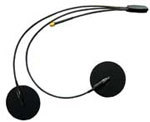 Chelton designed and developed a body-worn antenna
system that provided an improved signal pattern. The new antenna provides a greater all- round
coverage that cannot be produced by a single dipole (especially if a soldier's weight is pressing on
the radio, e.g. should they be laying down on it).
Chelton designed and developed a body-worn antenna
system that provided an improved signal pattern. The new antenna provides a greater all- round
coverage that cannot be produced by a single dipole (especially if a soldier's weight is pressing on
the radio, e.g. should they be laying down on it).
A further benefit is provided by circular
polarisation, that alleviates the problem of polarisation mismatch when soldiers are in different
orientations with respect to each other.
These antennas have the added advantage of being
small, wafer-thin and very lightweight, making them less intrusive and more comfortable for the
wearer, an important aspect when considering the weight of equipment to be carried. The patch
antennas, being remote from the radio, can be located higher on the soldier’s body, allowing the
radio to be located in a less critical place, such as at waist height.
In trials, each
soldier was equipped with a Marconi Selenia Data Enabled Personal Role Radio (DEPRR) with the Cobham
dual-patch body-worn antenna sewn into clothing.
Initial results for the new antennas showed that RF performance was good, sufficient for them to be
considered for future variants of the Soldier Modernisation Programme.
Contact us direct for
more information: newmarket.sales@chelton.com,
or telephone +44 (0)1638 732177.


